By: C. Fraser

Edward Elgar premiered his Variations on an Original Theme, commonly known as the “Enigma Variations” in 1899. In the program notes for the premier, he noted that there is a ‘larger theme’ present that is never actually played:
The Enigma I will not explain – its “dark saying” must be left unguessed, and I warn you that the connexion between the Variations and the Theme is often of the slightest texture; further, through and over the whole set another and larger theme “goes”, but is not played . . . . So the principal Theme never appears, even as in some late dramas – eg Maeterlinck‘s L’Intruse and Les sept Princesses – the chief character is never on the stage.
Later, Elgar spoke to Musical Times:
Mr Elgar tells us that the heading Enigma is justified by the fact that it is possible to add another phrase, which is quite familiar, above the original theme that he has written. What that theme is no one knows except the composer. Thereby hangs the Enigma. — F.G Edwards, Musical Times, 1900
Five years later, he spoke to a biographer:
“The theme is a counterpoint on some well-known melody which is never heard.” – Edward Elgar as relayed to his biographer Robert John Buckley, 1905.
We may never know the true hidden theme, as Elgar supposedly revealed it to no one during his lifetime, and we assume that no one found the solution. All we can do is make educated guesses at this point based on criteria from the sources listed above.
What are the criteria for this hidden theme?
- The hidden theme must be a familiar piece of music
- The hidden theme is never played
- The hidden theme must run counterpoint to Elgar’s main theme (the assumption is usually made that he means the first 6 bars of his piece, although this was never made clear)
- The hidden theme should involve a “dark saying”.
- This theme is present “through and over the whole set”
What is the hidden theme behind the Enigma Variations?
I am proposing that the hidden theme that runs counterpoint to Elgar’s theme is the beginning of Beethoven’s 5th Symphony; the famous short-short-short-long theme that was very popular during Elgar’s life and remains popular to this day.
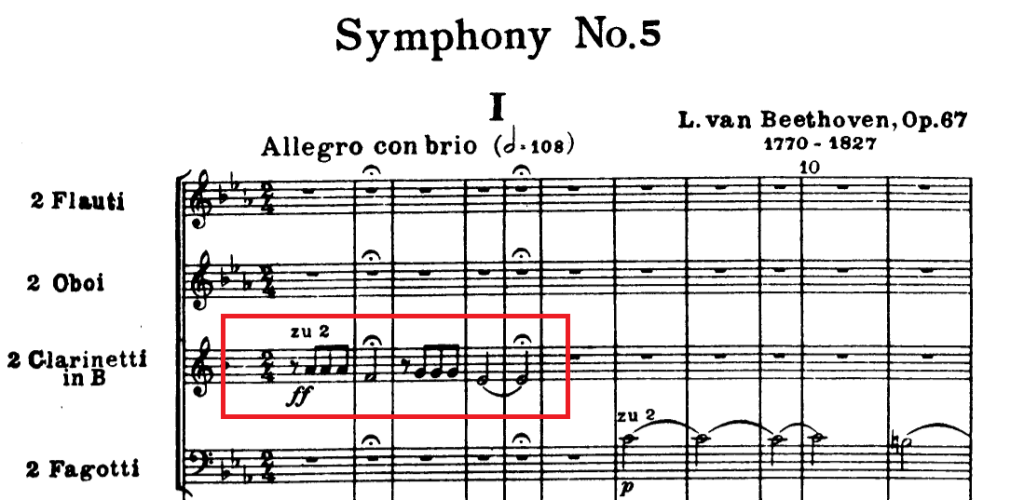
Here is the counterpoint above Elgar’s theme to support my theory (with the Beethoven counterpoint in the piano and the Elgar theme in the Violins):
Here is the audio to accompany the score:

I believe that this satisfies at least the first three criteria.
- Beethoven’s 5th Symphony, especially the opening theme, is one of the most familiar pieces of music of all time.
- There is no evidence this Beethoven theme is ever played note-for-note within the Enigma Variations.
- The counterpoint example above shows that Beethoven’s opening theme can be written above Elgar’s opening theme and ‘fits’ with the theme. One can hum the tune easily above Elgar’s theme, as they are both in the minor mode. **** I had to alter the note qualities to 16th notes in triplets, but since the two pieces were written in different time signatures and tempos, this was necessary. I also will share some evidence later in this post regarding my use of triplets, as I believe Elgar “hinted” at it in his last movement****
What about the “dark saying” ?
I believe that the counterpoint alone can justify Beethoven’s 5th opening theme as the hidden theme, but there are other non-musical reasons, as well. For example, Elgar wrote that the hidden theme was a “dark saying”. What is it about Beethoven’s 5th that is a ‘dark saying’? Does it have some sort of nickname?
In fact, it does. It was, and still is, known as the “Fate motif”. The phrase was also likened to “Fate knocking at the door” by several scholars and admirers. “Fate knocking at the door” in a minor key, as it was written, could be taken as ‘dark’ or foreboding. Beethoven himself never acknowledged the nicknames as fact, but when it came to popular culture, there are many references to this theme as “Fate knocking at the door.” It is very possible that Elgar knew of this nickname and phrase, having been such an admirer of Beethoven. Could it be that Elgar saw this phrase as the “dark saying” ? Is Fate the unseen guest lurking among Elgar’s musical variations?
Is the hidden theme present through and over the whole set (meaning the 14 variations)?
One could argue that the hidden theme is present any time Elgar’s main theme is present, as the hidden theme is never actually played, but is supposed to run counterpoint to Elgar’s main theme. Elgar wrote all 14 variations based on his theme, so any time you hear the Elgar main theme, the hidden theme lurks in the mind of the listener. However, I believe there are some “hints” in a couple of the movements that I will detail below:
Hint 1:
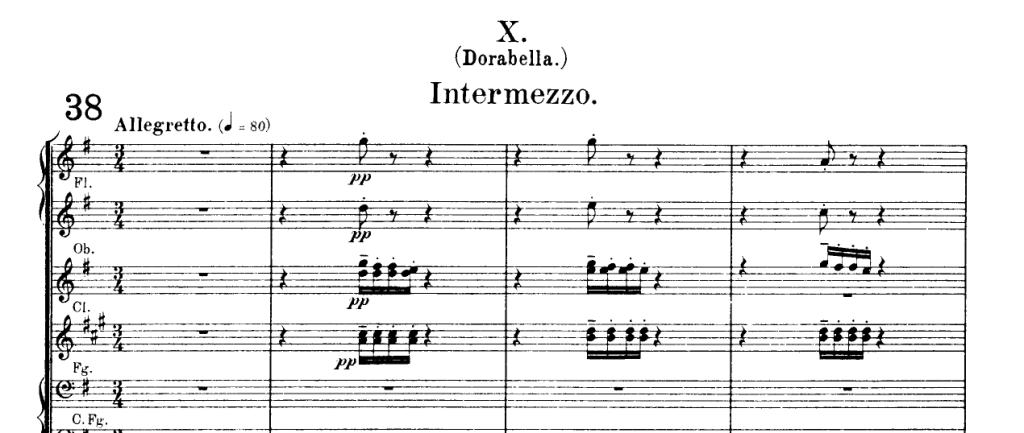
Variation X (Dorabella):
There is a four-note theme that plays throughout the Dorabella movement that hints at the hidden theme I am proposing. It could be called a backwards version of the famous “short-short-short-long” Beethoven theme. Elgar floats a “long-short-short-short” theme in the woodwinds throughout the movement as indicated not by rhythm, but accent markings:
Hint 2: Finale:
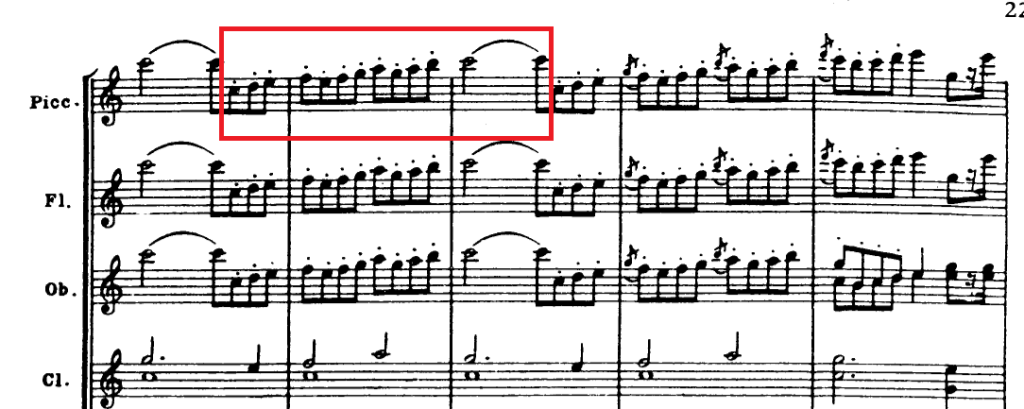
I believe there is another, more obvious, hint in Elgar’s last variation “EDU”. In it, the flutes play a variation of the main theme, but the woodwinds play a very distinctive “short-short-short-long” motif along with it that runs counterpoint. Elgar was very careful to not use the Beethoven melody, but makes up his own melodies while keeping the rhythm consistent:
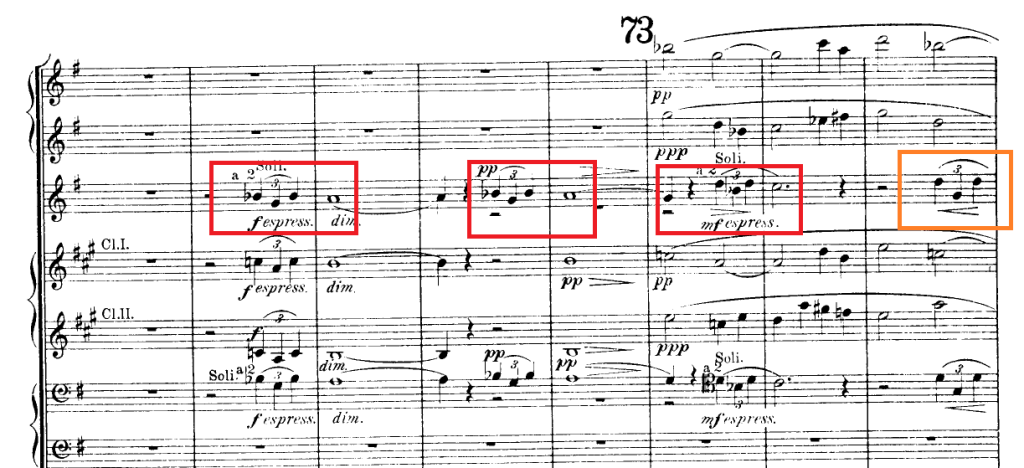
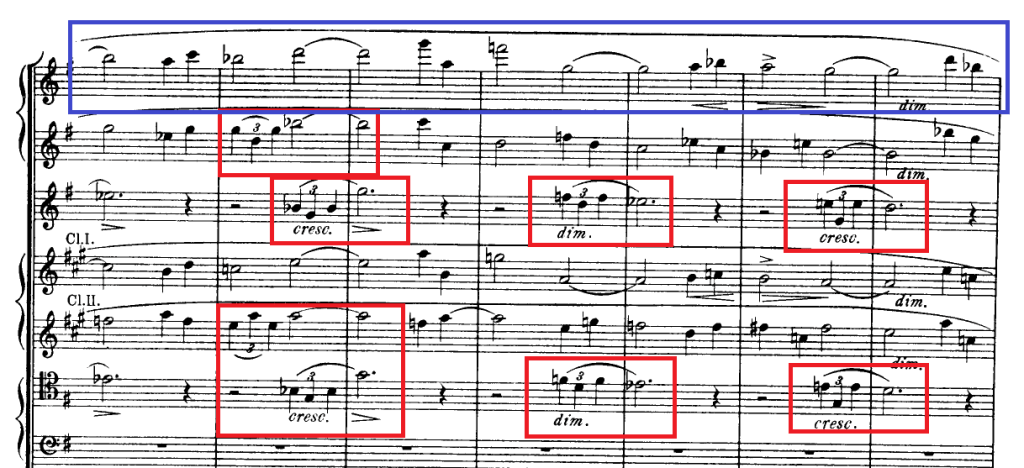
In the examples above, the flutes play a variation of Elgar’s main theme while the woodwinds play triplets in a “short-short-short-long” motif. I believe that this is a hint as to how the counterpoint works when it comes to discovering how Beethoven’s melody fits above Elgar’s main theme. This is why I decided to use triplets in my example, as it just makes sense from a rhythmic perspective.
Is there any other evidence?
I have some other theories as to how this theme may be expanded to include the rest of the bars from the first movement. I feel, first and foremost, that Elgar intended his hidden theme to be the first 6 bars of the opening movement. However, if he meant it to extend past bar 6, there is another passage in Beethoven’s 5th that I think fits with the Gmajor portion of his main theme. It is a passage in the last movement of Beethoven’s 5th highlighted below :
Here is the G Major portion of Elgar’s theme in the violins and the Beethoven theme that runs counterpoint to the measures 7-10 with audio below:
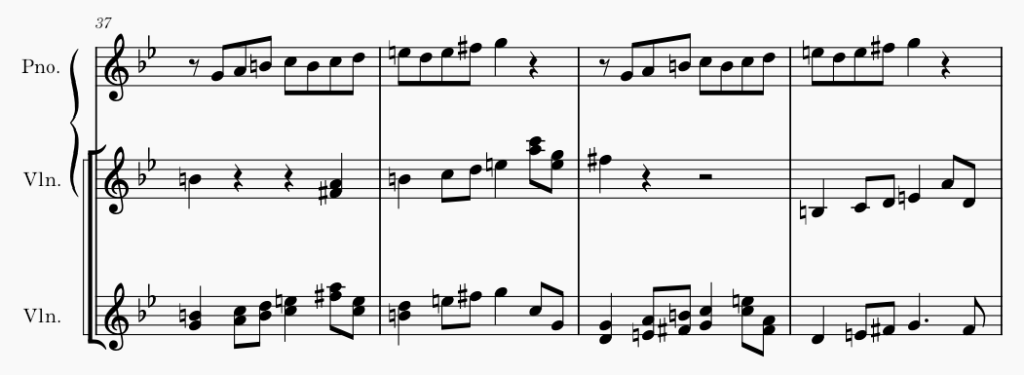
I present this with the caveat that it is not as ‘famous’ as Beethoven’s Fate Motif and therefore might not be involved in the hidden theme. However, it is pretty recognizable if you are familiar with Beethoven’s 5th.
Other notes:
I think it’s entirely possible to extend the first few measures of Beethoven’s 5th theme beyond the initial two bars to fit Elgar’s main theme. It just doesn’t fit as well, harmonically in measure 4, but it is a possibility that the melody extends:
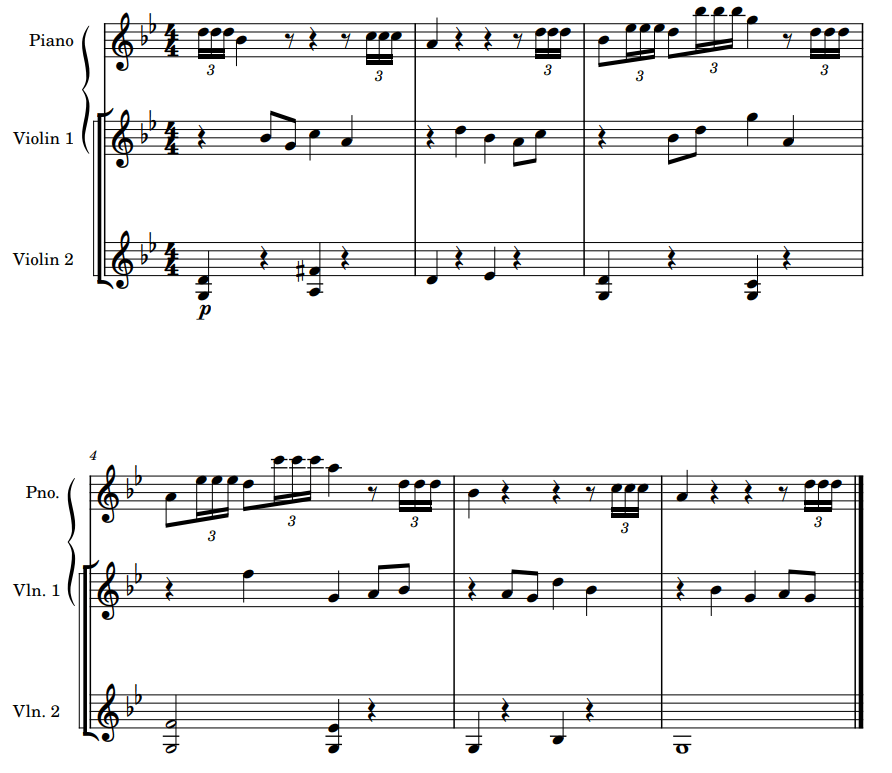
There is likely more evidence to unlock regarding this theme within the Enigma Variations, so I hope people can see and hear what I’m hearing and contribute to the conversation. Elgar’s Enigma Variations is a wonderful piece of music on it’s own accord, but this puzzle just makes it all the more interesting.
 Elgar's Enigma: A solution in Beethoven's 5th
Leave a comment